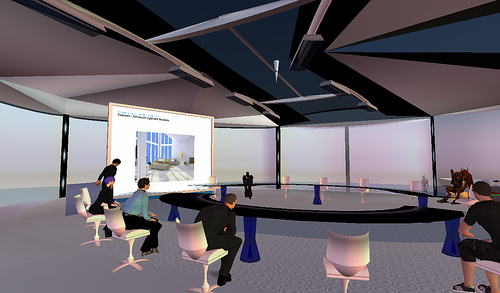
Virtual technology is being hailed by experts as one of the possible answers to the credit crunch, as web designers look for that extra wow factor that can give their sites the edge in the economic downturn.
Having already been the victim of one false dawn eight years ago, 3D technology is beginning to emerge from the technology shadows as one of the most exciting developments on the internet.
A computer generated 3D image of a room that does not exist. (Image courtesy of United Lane)
“The trend is very clear,” said Ramani Karthik, Professor of Mechanical Engineering at the US’ Purdue University and an authority on 3D technology.
“The real world is 3D and as humans we want things to behave in the way that they do in the real world, so going to 3D is very natural it is the next evolution of the web.”
The claims have not gone unnoticed by internet companies like Google and Microsoft which have developed Google Earth and Microsoft Virtual Earth in what appears to be a race to capture the world in 3D on the web.
Developments that are now exciting traditional industries such as building sales, furniture design and are also spawning a whole new virtual world industry, far removed from current technologies like Second Life.
“The rate of development of these technologies is already having an impact on the US real estate market,” said Doug Garcia, the director of research, for Colliers Parrish, a large real estate group based in the San Francisco area.
“We’ve explored using 3D modelling on the market and can are working towards a future where actual 3D tours will allow you to go to different floors of a building and look around the location using Google Earth.
“Increasingly we think that people will want to use 3D to assess the value of a property remotely and the challenge there will be in the refresh of the 3D worlds that will evolve, though I could see that happening with social networking for an area where people will work to contribute information,” said Garcia.
And while companies like Google focus on the outside, other companies are now working hard to create interiors that show off products.
United Lane, a Danish 3D company, wants to make a closer association with the real world, according to Kresten Thomsen highlighting, the company’s Chief Technology Officer.
“Our aim is to make 3D technology available to anyone using the web.
“So what we do is let people upload plans of their own houses from a 2D floorplan and populate it with real furniture and objects, change floors and wall colours and then render the whole thing in a photo-realistic fashion, simply because people find that more compelling and attractive.
A speed boat that can currently only sail in cyberspace
“In our visualisations we can even add the view from a window, that is how I see the internet going it will be a believable mirror of the real world.”
United Lane can make photo-realistic images of buildings that do not yet exist in a remarkably short space of time, VZillion, a company that is betting on 3D technology being the next stage of the internet, wants to go further.
In line with the old vision of the internet bubble at the turn of the century, when developers promised a photo-realistic world inhabited by life-like avatars of real people, according to VZillion it’s going to be 3D with everything.
“We think in 3D and we feel things in 3D. If you look at a virtual world you see an environment you are engaged with,” said Antonio Collier, the company’s CEO.
It’s offering for the future is a 3D virtual world where you are given the keys to a virtual flat that can be populated with the objects that you use in your everyday life.
Objects that according to Collier, will work in much the same way that they would if they were in your real room.
“You will be able to go to Amazon and point and click and play a music movie on the TV in your virtual appartment,” said Collier.
Potentially, a move to mesh the real world with Second Life that might have implications for both.
Professor Karthik, who worked last year at the prestigious Stanford Research Institute in California, adds that the key factor in the use of virtual environments for people is the amount of data that a 3D world can convey.
“I have worked with cognitive psychologists and we have looked at the way that people like to navigate 3D content, we gave them the ability to take snap shots from within the visualisation and found that people always choose positions that allow them to convey the maximum amount of visual content.
“Of course there has to be some value for the 3D visualisation to be useful and we found that people considered the 3D interface much more intuitive than a 2D one.”
Part of the reason for this, according to a study carried out by scientists at Washington’s Johns Hopkins University is because our brains find 3D environments more reassuring.
The Johns Hopkins research suggests that the part of the brain governing vision is able to map out a copy of a 3D image by projecting it onto responsive neurons that can create a 3D model of an object.
“Human beings are keenly aware of object structure, and that may be due to this clear structural representation in the brain,” Charles E. Connor, associate professor in the Zanvyl Krieger Mind-Brain Institute at The Johns Hopkins University, told Science Daily in October of this year.
In the study Connor and a colleague Yukako Yamane, a postdoctoral fellow, trained two monkeys to watch a computer screen while 3D objects were played upon it while the researchers recorded the responses of neurons in the higher-level part of the visual area
According to Connor the research may ultimately lead to the reasons why our brains find some objects and views visually pleasing and dismiss others.
Suggesting that there may be an element of ‘pleasing comfort’ created in the brain among groups of neurons when they display an object.