April 16, 2013
A stark report from the World Economic Forum has warned that lack of access to the internet is creating centres of data poverty across the globe. A problem that is often more to do with geography than money.
According to the WEF analysts, the internet, rather than being a worldwide web, is actually limited by ‘hotspots and notspots’ and if you live or work in a ‘notspot’, you are a digital nobody, with dire consequences for your education and economic potential.
Deepening digital gulf
The greatest gulf lies between the developing world and the highly-connected West says Thierry Geiger of the World Economic Forum’s Centre for Competitiveness and Performance in Geneva, Switzerland who has been studying the effects of a lack of Internet access.
“In sub-Saharan Africa, the internet remains a privilege of the very few. Mobile telephony is the only technology that is widely available, with double-digit growth in most countries”
“It’s a lost opportunity to improve productivity. It’s also a key to improving governance, security and indeed survival,” said Geiger, stressing that the WEF report also examined property laws, regulation, content creation, and the vision of an area’s Government in making sure that technologies are properly used.
All factors crucial to internet adoption because if there is nothing available in your language or relevant to your culture, then you will not engage with the online world and with many of Africa’s 1,500 different languages being oral with no written alphabet, this mean that voice-based communication – such as mobile phones and FM radio stations – predominates across the continent.

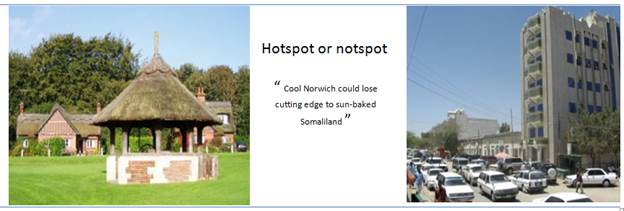
Parts of UK suffer worse data poverty than Africa
A digital divide that the Government’s sale of its fourth generation (4G) spectrum to the EE group – formerly called Everything Everywhere – was meant to address, according to Oftel, 4G would provide high speed mobile broadband to over 97% of the country. Yet even with very low internet penetration, some African countries such as Angola and Somaliland still enjoy faster broadband speeds than the wealthiest of England’s shire counties complains Peter Chadha who runs a global IT consultancy and points out data poverty is not just about money: “I need to communicate with my colleagues by videoconference every day. That’s how we work. It works fine with consultants in Somaliland but one of my best workers at his home office just outside Norwich is one of the most remote.”
Unfortunately as of last week EE is certainly not providing ‘everything everywhere,’ but rather super-serving ten favoured cities and leaving the countryside to fend for itself, a policy favoured by most other telecoms companies and one that DEFRA the Department for Farming and Rural Affairs and the Carnegie UK Trust say has to be reversed.
The Trust’s Douglas White explains that funds are available from this philanthropic giant that endowed many British towns and cities with public lending libraries in the nineteenth century. “And it is not only money,” says White. “We also have five field officers across Scotland, and we can offer advice for anyone in the UK who wants to set up their own community broadband hub.”
These communication hubs could replace the traditional pub as the heart of the village, suggests Matthew Howett of research analysts Ovum. The hub could be linked up to a sustainable energy source such as a wind turbine and people living in the community could each agree to pay a monthly subscription to control their own broadband access.
Digital haves and have nots geography as well as poverty
Initiatives certain to meet the approval of the coalition government as examples of ‘The Big Society’, its policy of promoting self-help solutions to problems abandoned as unattractive by big business. Politicians including Lord Shuttleworth, the outgoing head of the Rural Development Commission and junior minister Dr Dan Poulter MP agree that faster broadband is vital to re-energise rural life and relieve data poverty, and both have promised to campaign for improvements.
Several alternative models also exist. For example, Gigaclear boasts broadband speeds of 1000mbps at its flagship village schemes in Appleton and Eaton in rural Oxfordshire and has just announced the launch of another site in Uppingham.
At her farmhouse near the village of New Buckenham in Norfolk, journalist Janet Trewin can only dream of such speed and efficiency. “For two years Talktalk tried to get our broadband connection to work reliably. Then they gave up and we switched to BT. They still can’t make it work – but at least they have agreed that I no longer have to pay for a service I’m not able to use”.
Meanwhile her counterparts in rural Germany are already benefiting from the federal government’s policy of insisting that the successful bidders for 4G must roll it out first to small towns and villages, aiming for blanket coverage rather than urban hotspots. Richard Strike of the Adva network systems company says his home in a village near Munich has faster, more reliable connections than his family gets in the Suffolk county town of Ipswich. This, he maintains, is good for his business and his quality of life.
So does he think the British Government should follow Germany’s lead?
“That’s not for me to say – it’s up to the politicians.”
An uncanny echo of Geiger’s conclusion that the internet success of a nation is dependent on the vision of the Government.