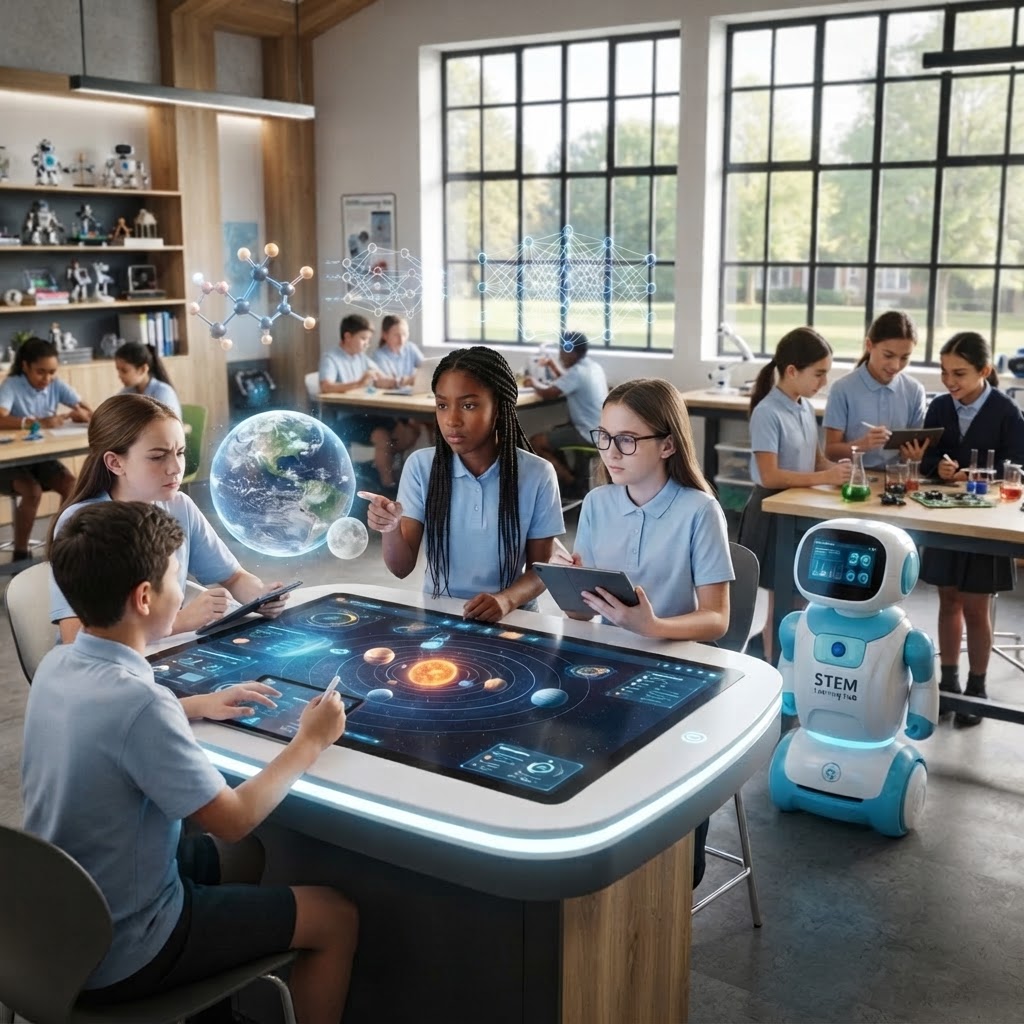
Imagine a world where you can enter millions of worlds, imagine a world mirroring our universe, then you have just imagined the Omniverse, the world the computer graphics giant Nvidia is building.
The Omniverse is an ambitious plan to copy the world build a virtual earth in cyberspace and link together real and fantasy virtual worlds that are already being used for work and play.
In an exclusive interview with Future Intelligence, Omniverse head Richard Kerris outlined why Nvidia believes that the future is quite literally virtual.
“There’s all sorts of worlds that we believe will be out there,” said Kerris. “Some will be 2D experiences that you will enter from your computer screen or your mobile and some will be full 3D experiences simulating reality.”
Worlds, according to Kerris, that Nvidia will link together with its Omniverse, creating an environment where you can work in a virtual office and use other 3D worlds that your employer has either created or bought entry into to do your job. It will be a virtual environment where you will also be able to shop and entertain yourself.

“There’s all sorts of things that will be out there. You will have architects and designers walking through a virtual building that they aim to construct and being able to experience it in all of its richness. There will also be entertainment-based environments where you could be in a surreal space and playing games or simply communicating with others and meeting new people. There are all sorts of things, there will be so much more of these worlds out there than we’re used to experiencing in the real world,” said Kerris.
One thing to rule them all
At the heart of this universe of worlds will be a uniting computer language called Universal Scene Descriptor, something that in Kerris’ words will be the HTML of the of the 3D worlds of the future the glue that holds them together and the oxygen that allows them to live and breathe.

“We’ve used USD as the foundation of the Omniverse, by having that we now have a common way with which to experience things and to connect all of these experiences together.”
While Nvidia might be appearing to be betting the bank on the Omniverse it has sound commercial reasons for building virtual Earth. It has been working with a number of commercial companies like BMW and simulating its factories in its Omniverse world. A simulation that allows the car company, which produces 2.5m cars a year, to model the changes needed to a production line to build a new car in virtual reality. This means that the costs of change can be kept to a minimum because they are not done in real-time in a physical world.

In the metaverse you will also be able to work because not only does it already allow you to generate documents and data that are instantly mirrored in the metaverse but you can also hold virtual reality meetings in very high resolution.
“We have a common foundation using USD. We’ve got 47,000 individuals and 400 companies using this right now. We meet in those environments all the time and we take it for granted that whether you’re across the room or across the globe that connecting on a project in a virtual environment is just second nature now. It’s really the way that people will do things and it’s obviously been accelerated over the past year due to the pandemic.”
Omniverse will be very real
It is a virtual world that is becoming ever more realistic according to Martyn Ware, a former pop star with the Human League and Heaven 17 who now produces highly sophisticated 3D soundscapes.
“It’s already happening. When we’re talking about international leaders’ summits, for instance, or major CEOs talking to the heads of departments of multinational companies, there are plenty of bespoke system where you can sit in a boardroom, and have projections of the different participants from around the world appearing in the room with individual sound sources locating them accurately. They can interact and share documents in a virtual space on the screens. This is all happening now.
The possibilities according to Kerris are virtually endless because of the ongoing data acquisition by companies, organisations, and nation states. A process that will eventually mean that even people, animals and plants will be modelled in the metaverses that Nvidia is seeking to unite in the future.
Using a combination of AI and big data even the flora and fauna of the natural world will be simulated by using calculations based upon species diversity and growth patterns a potential that will also allow the farmers of the future to plan their planting and achieve a more sustainable agriculture by calculating how to manage pests naturally by encouraging predator species.
The Omniverse is built on decades of AI thinking
A potential for simulation that has drawn concern from privacy and human rights activists who say that it is inevitable that the virtual worlds will be used to represent individuals and be able to derive behavioural data and mirror their responses. An insight that would enable companies to use the technology to model how to make particular products successful and whether people would be interested in certain things. It could also mean that companies could try to condition people’s responses and manipulate them according to some critics.
A use that Nvidia’s Kerris said the company was not interested in and that the uses of its technology were just modelling the characteristics of people in groups.

According to David Wortley, CEO & Founder of 360in360 Immersive Experiences, an expert in virtual reality who carried out pioneering work in VR environments as the former director of the Serious Games Institute at Coventry University, Nvidia’s Omniverse is one of the logical objectives of virtual reality development.
“We were doing experiments along these lines well over a decade ago in Second Life that were practical demonstrations that you could blend the virtual and the real together.
“In one we had a little plastic rabbit that we called Nabaztag that used to sit on my desk at the Serious Games Institute and it brought in lots of information that it was programmed to collect from the internet. Though it existed in my physical office it also existed in my virtual office so people could visit me virtually in my physical office because the Nabaztag would let them know I was there so they could come and have a conversation with me.
Privacy concerns over surveillance
“We did something similar with a dolls house that had lighting and heating sensors in it that also existed virtually in Second Life. You could activate lights and the heating in both the real world and the virtual world, so it’s not new,” said Wortley, who added that he did have reservations about the development of virtual copies of the world because of the potential to realistically portray and identify people.
“My major concerns with this are to do with the potential to be able to model an individual’s behaviour. A company can say that the data is anonymised, because if you are deriving data from people when they are in a physical space and translating that into a virtual space you need to have connections to them to be able to establish that.”
Wortley’s concern may be valid because as Kerris says while it aims at connecting metaverses together and achieving agreement on how things in the metaverses will be commonly portrayed it will not have control over the metaverses created by companies to depict their digital data. Already some companies such as Facebook are building what could easily be described as ‘dataverses’ where it is modelling not just the behaviour and sentiment of those people who have signed up to its services but also modelling the people who are not on Facebook, a process known as ‘shadow-profiling’.
Facebook has also set its sights on the 3.5 bn people not yet on the internet by promoting low-cost bandwidth options in poor countries sharing internet fibre lines to move data and inventing software for cheaper cellphone equipment. It has also made the blueprints freely available of a technology it designed that companies are using to make cheap internet equipment to attach to lamp posts or roofs in places where it’s impractical to tunnel underground to lay conventional internet pipelines either because of rock or freezing conditions. Alaska Communications confirmed its using gear based on Facebook’s designs for internet connections in Anchorage and Fairbanks.
Facebook also collaborates with partners in Peru on a mobile internet network in a sparsely populated area that would have cost too much for too little potential revenue for companies to wire those areas. The project now covers about 1.5 million Peruvians with 4G service since it started two years ago.
Metaverse or data verse?
All moves that will give it the data that it can pour into its own metaverse if it wants meaning that data in future can be modelled ‘virtually’ in any way a company chooses, as data or as a personification.
For the critics of virtualisation this will inevitably mean that the ‘big tech’ owners of the data lakes will be allowed to run rampant in a world which they will dominate and be able to decide who plays in the virtual worlds because they own the data. It will, in the event of the development of complete dataverses, provoke civil liberties challenges over surveillance and who owns what in the virtual world and whether a person in the physical world will also own their virtual embodiment.
And while presenting incredible potential there are many such as Massachusetts Institute of Technology Professor Sherry Turkle , the renowned humanist and author who most recently published ‘The Empathy Diaries’ who has strongly held reservations about the implications of the technological monitoring necessary to accurately depict a fully drawn metaverse.
“Everything is listening to you. Your television is listening to you. Everything on the internet of things is listening to you. Technology companies are listening all of the time so every aspect of you can be profiled in your intimate and non-intimate environments so a doppelganger of you can exist online whose political, personal, aesthetic, sexual desires can be marketed to before you feel them,” said Turkle, who insists that there now is the need for clear lines over what can and cannot be done in both cyberspace and the metaverse.
Realism of metaverses prompts calls for regulation
“At some point we are going to have to regulate because this is really out of control, at the moment we appear to be saying that a Chinese-style Big Brother is fine as long as it’s administered by capitalist countries. In my view this is really a life that will not foster intimacy, privacy, or democracy which I think are a golden trinity that we have to preserve,” said Turkle.
It is an objective that Kerris rejects, for him and Nvidia he says the aim is to use the virtual Earth to solve problems and challenges but perhaps the greatest challenge will be deciding what can and cannot be done in the metaverse and whether you and your actions belong to you.
Quite why this relationship between the physical world and the virtual Earth matters so much is pointed out by the former pop singer Martyn Ware.
“One of our ambitions always has been to create something ultimately that’s a bit like the holodeck in ‘Star Trek – The Next Generation’, where you can have a bit of downtime and you go into a virtual environment that sounds real, looks real, smells real, and to all intents and purposes, is real.”
Imagine that: worlds within worlds, on a spaceship travelling through galaxies.