

The UK must focus on data centre research to solve some of the massive infrastructure issues caused by the adoption of Artificial Intelligence.
Experts interviewed by Future Intelligence during the making of the PassW0rd radio programme into data centres, ‘Planning data motorways of the AI age,’ have warned that data centres are already creating water stress and energy issues that long-term will have implications for people and wildlife.
According to Professor Andrew Chien, of the University of Chicago, and one of the world’s foremost researchers on data centres, to avoid the systems now using AI competing with people for energy and power their siting and use must be carefully planned.

Within the next six years due to AI, Professor Chien said data centre energy use will grow sixfold in the US and at a similar rate in Europe.
Huge AI power demand predicted
“There’s no question AI has put this growth on steroids. And that’s because it’s a fundamentally different way of delivering services,” said Professor Chien. A difference, he says, that has happened because AI has turned web searches into computations that arrive at an answer for us instead of forcing us to do the searches ourselves.
“It’s made web search or queries like that into a compute intensive service, which is what this large language model is. It’s like a giant sparse matrix computation. It’s what you do every time you put 3 words into Chat GPT.”
It’s a development that means that the energy required is not only increasing, but so is the demand for clean water to cool the servers which now provide the backbone of our high-tech world.

“In the Western United States and in the South West US any industrial use that consumes water is in competition with wildlife and people. There are whole nations like India, where much of the country is in water stress all the time. So, they’re looking at it with the view of how do we develop this information economy we have to have and deal with those challenges?”
“China is often talked about as an AI competitor but China has huge water stress in many parts of its geographic area. The water is not well distributed. It’s a common problem and there’s parts of Europe that have the same issues,” said Professor Chien, a former Vice President in charge of research for the computer chip giant Intel, and an expert on the siting of data centres in areas of low water demand and renewable energy.
Data centres compete with people for energy and water
The issue of competition for water and power is so critical that the US National Academies of Science, Engineering and Medicine, in a conference last November, drew attention to the fact that in Northern Virginia, data centres were now in direct competition with the local population for energy and water.
A situation recognised on the website of the North Virginia Regional Commission, a grouping of 13 local councils.
“Sustaining reductions of greenhouse gases and supplying efficient and reliable energy to Northern Virginia’s data centres is a complex economic and environmental process.
“Northern Virginia’s 250+ data centres handle roughly 70% of global internet traffic. – the highest concentration of data centres in the world.
“There’s no question AI has put this growth on steroids. And that’s because it’s a fundamentally different way of delivering services.”
Professor Andrew Chien
“Collectively, data centres contribute over a billion dollars of tax revenue to the budgets of Northern Virginia’s local governments. Power demand in Virginia is expected to grow by about 85% over the next 15 years.
“By 2035 the industry in Virginia will require 11,000 megawatts – or nearly quadruple what it needed in 2022. The accelerated applications of artificial intelligence are projected to further multiply power demands over the next decade.”
A reality that will soon confront the UK due to the accelerated demand for data centres that the Government has stated that the UK must meet and one that is also being embraced across Europe.
Data centres at the heart of the AI arms race
Last year, datacentres were the great unknowns of the high-tech world.
This year because of AI they are at the top of the political agenda with both US President Donald Trump and UK Prime Minister Sir Kier Starmer already laying out ambitious plans to build high speed data networks.
The UK Premier announced earlier this year an investment of over £20 bn in creating a UK AI data centre, superhighway. While at the UK Government’s International Investment Summit last October even more money was earmarked for AI infrastructure. With the IT company Blackstone committing to a massive £10 bn AI data centre in Blyth in Northumberland and the US company Amazon Web Services pledging £8 bn on AI development.
In the US Donald Trump has dwarfed this announcing a staggering $500 bn Stargate project.
Developments Europe has matched. On the 10th of February, 2025, at the Paris AI Safety Summit, President Emmanuel Macron announced France would be spending €109 bn on data centres and AI over the next four years, an equivalent amount he stressed, in terms of population, to that being spent by the US.
Planning infrastructure at the heart of our AI future
Two days later at the end of the Paris AI Summit, the EU President Ursula Von Der Leyen announced, “The AI race is far from over,” in a speech, declaring further tens of billions of AI investment.
An announcement that followed the private €150 billion EU AI Champions initiative revealed the day before. Von Der Leyen added that an invest AI initiative would “top up” these investments by €50 billion, making it the largest public-private partnership in the world.
It’s a race that is increasingly leading to calls for regulation and control, which until the Paris Summit, had led to broad international agreement. One dismantled by the US Vice President JD Vance, in a speech in Munich immediately afterwards. Interpreted by many as fighting the cause of the US big tech companies, like Google, Meta, and Amazon, Vance said it was essential if AI is to develop, for the technology to be regulation free.
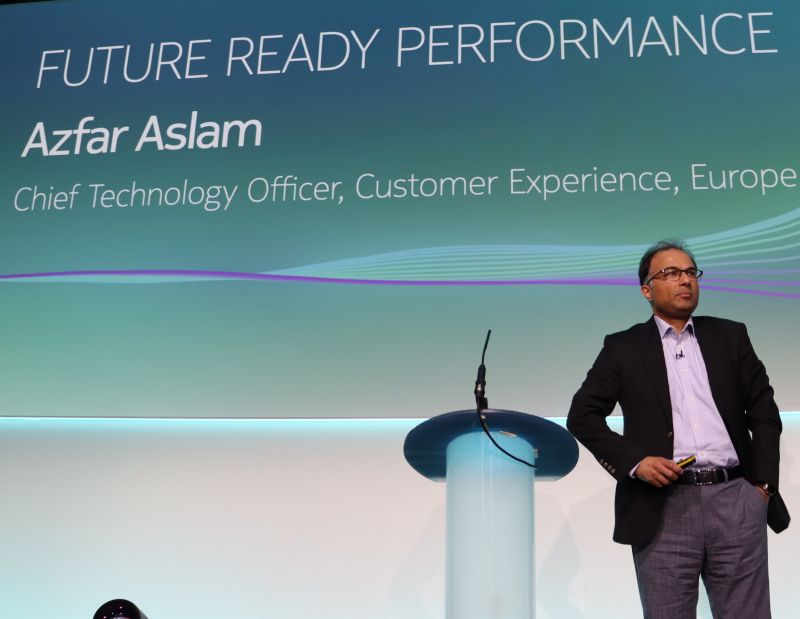
It’s a whirlwind of pledges, announcements, statements and counter declarations that, according to Dr Azfar Aslam, Nokia’s head of research now hide a massive issue. What to do.
Nokia was a mobile phone company that has now morphed into an international telecommunications company, a move forced upon it by the collapse of its dominant position in the mobile phone market.
An experience that threw it back to reinventing itself through its understanding of the underlying mobile phone infrastructure, and the company’s move into telecoms infrastructure.
Designing the new world
It’s something Dr Aslam says that we will now have to do if we are to avoid the very real problems stressed by Professor Chien.
“What you’ve got to look at is that this is an infrastructure that has evolved which was a technology that followed a business problem. We now need to pay more attention to the infrastructure build and have a structured approach to make sure we pay sufficient attention to it as a critical infrastructure. If you think about the wider economy, the society. It’s staggering. Economies run on this infrastructure, societies run on this infrastructure, government and defence now run on this infrastructure.
“We need a strategic plan to be able to meet future requirements, there’s got to be a structured approach. We are seeing that across the world in certain countries and regions and Europe is one of those. If you look at these innovations in the renewable sites where companies have started to test out these technologies.
“We’re working with a customer in Norway, for example, that is building data centres close to national resources for cooling and water and renewable energy in the same location. I think as these capabilities mature; we will see a more data centres in these renewable locations. Obviously not all locations will be suitable, but at least the trend is starting.”
To listen to the PassW0rd programme, click on the link below.






There is no question that beyond the limited data center center capacity, (limited CPU and storage) and algorithm efficiencies, the ultimate AI obstacle is energy and electric power for the hardware and its cooling. Data centers are on the Moon are looking a lot more attractive these days…. just because of the very low temperature – especially for the Age of Quantum Computing that is fast approaching.