AI in schools sparks backlash
among academics and parents
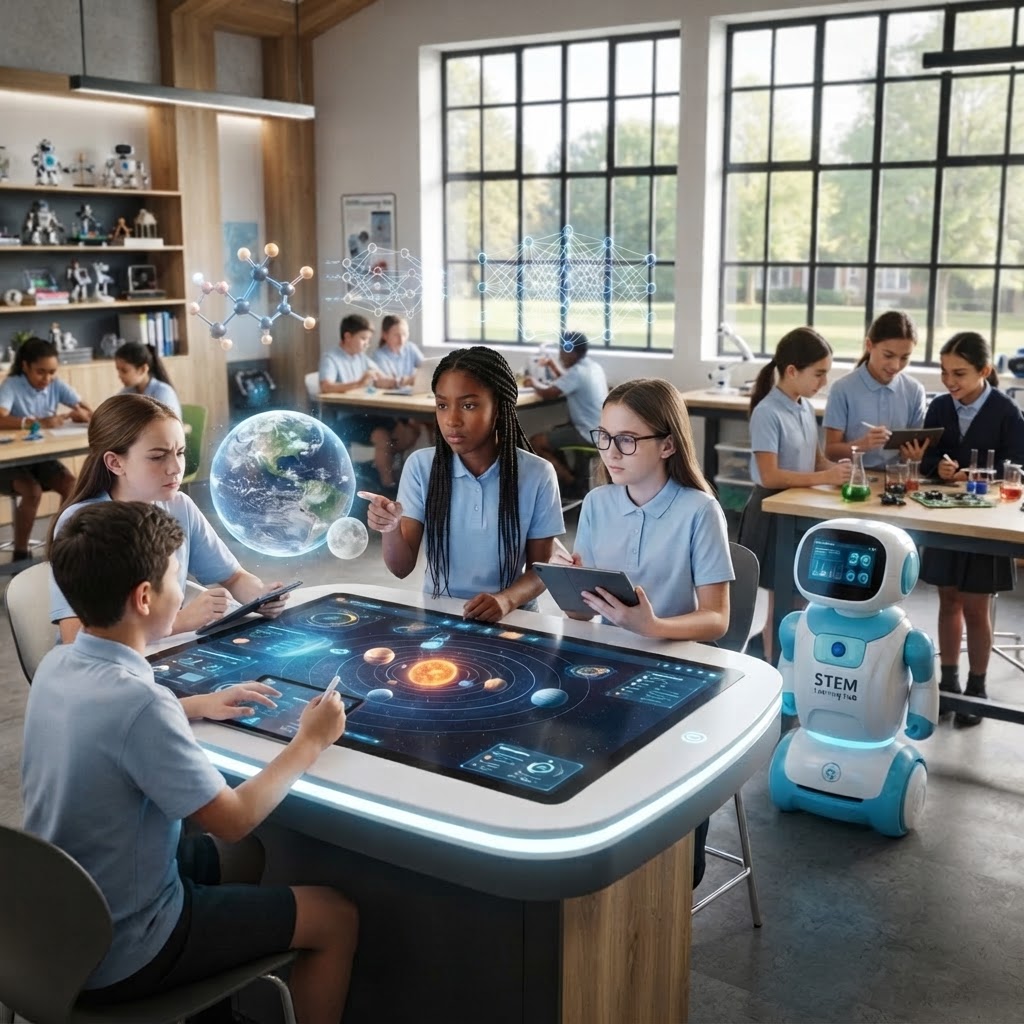
Apush to put AI at the heart of education has provoked a massive backlash among academics in Europe and US parents, with opponents condemning classroom AI use as experimenting on children with unproven technology.
The vocal opposition from academics and parents comes in the wake of sustained attempts by education authorities to introduce AI technology in a bid to keep schools abreast of the latest in technology – even as many children still struggle with a basic digital divide in the classroom.
“There is no independent evidence at scale for either the effectiveness of these AI tools, or the safety of these AI tools, or even the positive impact of these AI tools in educational settings.” Wayne Holmes, University College London
Experimenting on children

AI in schools is a trend that has been challenged by academics like Wayne Holmes, Professor of Critical Studies of Artificial Intelligence and Education at University College London, the UNESCO Chair in the Ethics of Artificial Intelligence and Education, who also works with the Council of Europe on AI literacy. “There is no independent evidence at scale for either the effectiveness of these AI tools, or the safety of these AI tools, or even the positive impact of these AI tools in educational settings,” Professor Holmes said.
“Every time a school, or a minister, suggests that these tools are used in an educational context, they are sanctioning experimenting on children,” Professor Holmes said.
Drawing a pointed comparison between medical adoption and the use of technology, Professor Holmes added: “When it comes to medicines, we have robust protocols. But when it comes to these technologies and education, that all goes out the window.”
Debating the evidence in Paris
This week in Paris, UNESCO – the United Nations Educational, Scientific and Cultural Organisation – is debating precisely those issues at a conference called Digital Learning Week – “Education in the age of AI: Facts, Frictions, Frontiers” – which is expected to also be the venue for a joint Ministerial statement on sustaining education as a common good in the age of AI. It is a debate Professor Holmes is moderating, and one that Future Intelligence's ‘PassW0rd’ radio programme on London's Resonance FM has been following in detail.
In this month's programme, ‘AI in the Classroom: Teacher's Pet, or Parent Panic,’ we interview the education ministers, academics and opponents at the forefront of the initiative and explore both sides of the issue. The wider question of how far we should trust AI systems is one Future Intelligence's sister publications have also been examining – the Cyber Security Research Institute from a security perspective, and TechTV.live in a recent discussion on AI and anthropomorphism with Cambridge AI ethicist Jonnie Penn.

‘AI in the Classroom: Teacher's Pet, or Parent Panic’ – the full ‘PassW0rd’ programme, broadcast 9 September 2026 on Resonance FM.
Parents take to the streets
In the US, as part of the backlash, parents have become involved in protests and legal action. Last week in New York City, a seven-hour public meeting saw parents and students demand an outright moratorium on AI in classrooms and forced officials to scrap a planned AI-themed high school.
According to one protestor, James Baker, who is so concerned about the trend he has joined with others to form Parents for AI Caution in Education Spaces, the point of education is being lost in the race to install AI in classrooms. “When I think about the role of education I think back to John Dewey, the role of democracy in education to raise people's awareness and raise people's status out of poverty – out of intellectual and moral and physical and economic poverty – is a powerful one,” Baker said. “And so if we are replacing that institution with a machine that is trained on all of our history to do X, Y and Z, and run by a Sam Altman, a Peter Thiel, or whomever – or Putin, or whomever – that's extremely dangerous. That is not a future that I want my children to be a part of.”
Teachers' unions in the US have gone even further: the American Federation of Teachers wants a total screen ban for the first three years of primary school, and a ban on AI companion chatbots for under-16s. In Massachusetts, a teachers' union has threatened legal action to block a school built around an AI-driven, teacher-light classroom model. Parents in Oregon have had a children's AI chatbot pulled from schools over fears it was fostering unhealthy emotional attachments in kids.
“Learning is about cognitive struggle, about the effort you invest. Where AI helps you personalise that effort, you win.” Professor Andreas Schleicher, OECD
The case for AI in the classroom
Though there is another side to the argument. Many parents want their children to use AI, so they won't be left behind when they enter the workforce, says Keri Rodrigues, founding president of the National Parents Union. “Parents want their kids to understand how to utilise this technology,” she said.

And other academics are championing the use of AI in the classroom. Professor Andreas Schleicher, the OECD's director for education and skills and the architect of the revered PISA rankings for national educational attainment, who was also interviewed for the ‘PassW0rd’ programme, shares Professor Holmes's caution about careless deployment, but reaches a different verdict. “AI is a genuine game changer,” he said. “In the Industrial Revolution, we lost many beautiful things we could do with our hands, because machines could do them better. Now we are at risk of losing many of the capabilities of our brains through AI.”
Though Professor Schleicher's main worry is not the technology but how it's used: “It's the thoughtless application of AI that worries me most, not the conscious deployment of AI, which has huge potential. One of the biggest mistakes we made in the history of education was to divorce learning from assessment – we call that an exam. That has created many of the problems we see today, making learning superficial. Learning is about cognitive struggle, about the effort you invest. Where AI helps you personalise that effort, you win.”
A two-kilometre-thick wall
Other opponents of the move to bring AI systems into education are adamant that safeguards must be put in place over its adoption, given the potential for AI companies to create lifelong dependency on their products – an issue Finn Majlergaard, author of ‘The Dangerous AI Gamble in Education’ and Professor of cultural and emotional intelligence, innovation and change at France's prestigious Emlyon business school, is particularly concerned about. “Literally, no one has ever proven there are any benefits of applying artificial intelligence to higher education,” he said. “We can also see the negative consequences: students facing psychological damage, feeling more lonely, more stressed out.”
“The main purpose for the big tech industry is to sidetrack professors into becoming learning coaches, sitting on the side, helping these systems become better and better, so they eventually become totally redundant,” he said.
Citing MIT research on brain activity during AI-assisted tasks, Professor Majlergaard added: “It's really terrifying to see how lazy our brains become when we're using ChatGPT to solve common problems instead of thinking. It opens a huge opportunity to manipulate us politically, because our brains become lazy and just absorb whatever the AI engine is feeding us.”
Professor Majlergaard is advocating for neither a ban nor a free rein: “I don't think we can ban it. We need knowledge about how to control it – there should be a two-kilometre-thick wall between the people making the decisions to bring it in, and the people actually delivering it.”