
Epping Forest District Council had to tell the people of Loughton that a data centre was coming to Langston Road. The law demands that, so long as it meets minimum requirements, how it does it, is up to it.
Councils, Kay Anderson, explains, need only put “one sign on one lamp post and one advert in one newspaper”.
According to Anderson, an ardent anti-data centre protestor, the lamp post chosen for the notice stood on a stretch of road that nobody walks down. When Anderson went out to talk to residents, hardly any of them knew.
Anderson is not a neighbour of the proposed data centre. “To be completely frank, it’s not actually in my backyard,” she says, during our Zoom call from her house.
Anderson’s expressive, and excited, and demonstratively moves both hands as she talks. “I live on the other side of the Forest,” she says but she loves the mix of ancient woodland, heath, grassland and wetland on London’s doorstep, that she calls “a magnificent rainforest”.
By her count three data centres are now planned or mooted within a mile or so of its edge, at Loughton, at North Weald and at Chigwell.
A professed “animal nut”, she worries about what their heat, their generators and their low hum will do to the creatures that live there. What angers the people she has spoken to, she says, is simpler. “Nobody was asked about it.”


Across Britain, and well beyond it, people like Anderson are suddenly discovering the buildings that run their lives, and they do not like what they find.
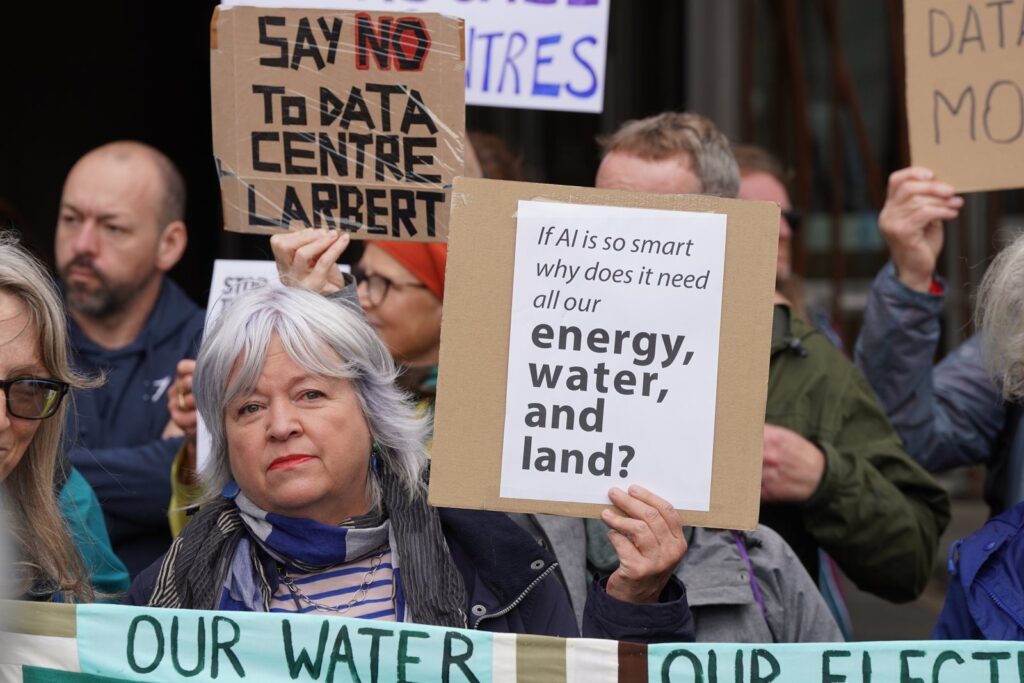
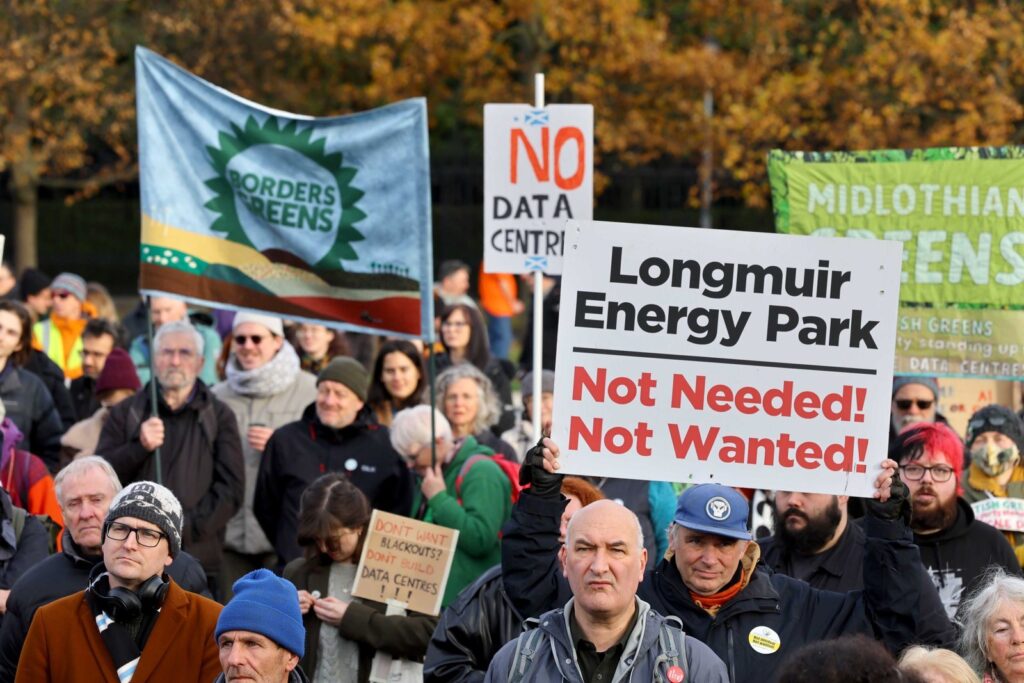
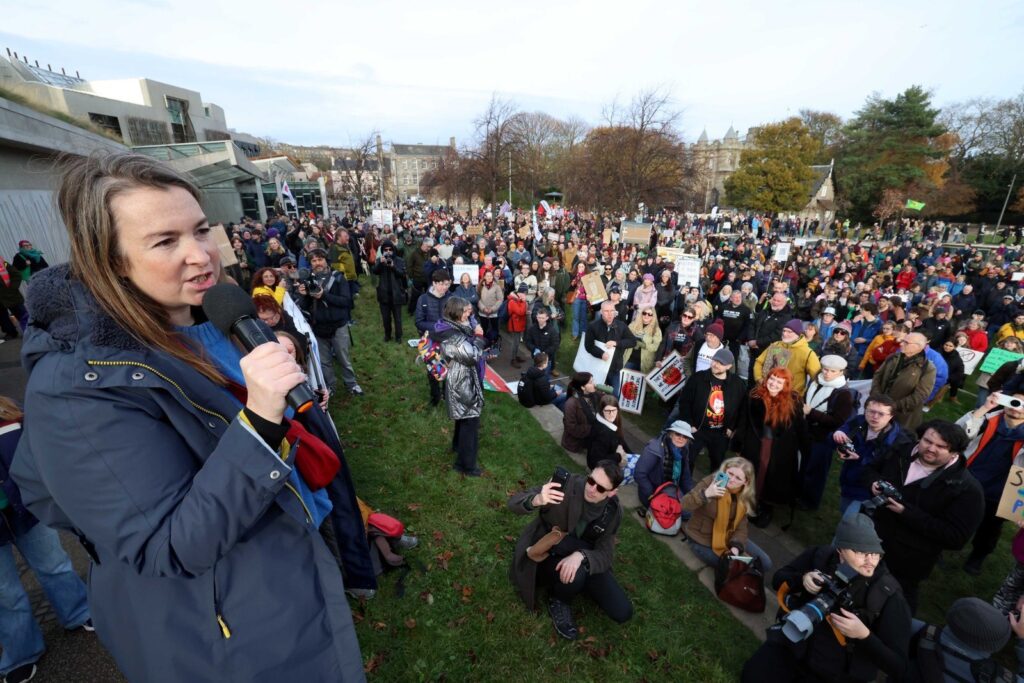
On 7 November she joined a day of protest co-ordinated by the campaign group Global Action Plan, one of some 20 actions in Britain that weekend, in places including London, Leeds, Reading, Nottingham and Epping, and part of a wave across Europe. About 70 people marched through Cardiff Bay against a data centre planned for a park-and-ride site, an application Welsh ministers have since called in. A week later some 6,000 people marched through Edinburgh.
While in the US a similar backlash has led to demands for moratoriums. In Texas, which has become the centre of the AI building boom, the incoming Democrat Gina Hinojosa swept into the governorship as part of the “bluenami” on a promise of an immediate moratorium on all data-centre approvals. Elsewhere in America between 440 and 500 local moratoriums are now reckoned to be in force. Data centres according to pollsters were a key part of the Democratic victory.
In the dystopian 1967 novel ‘The White Mountains’, John Christopher wrote about a superior technology that had enslaved and subjugated humanity. His Tripods, vast three-legged machines, had ruled for so long that nobody questioned them. At fourteen every child was “capped”, fitted with a metal mesh that left them placid and content, and only a handful of runaways escaped to the White Mountains to live free. The machines ruled not by force but because people had long since stopped seeing them.
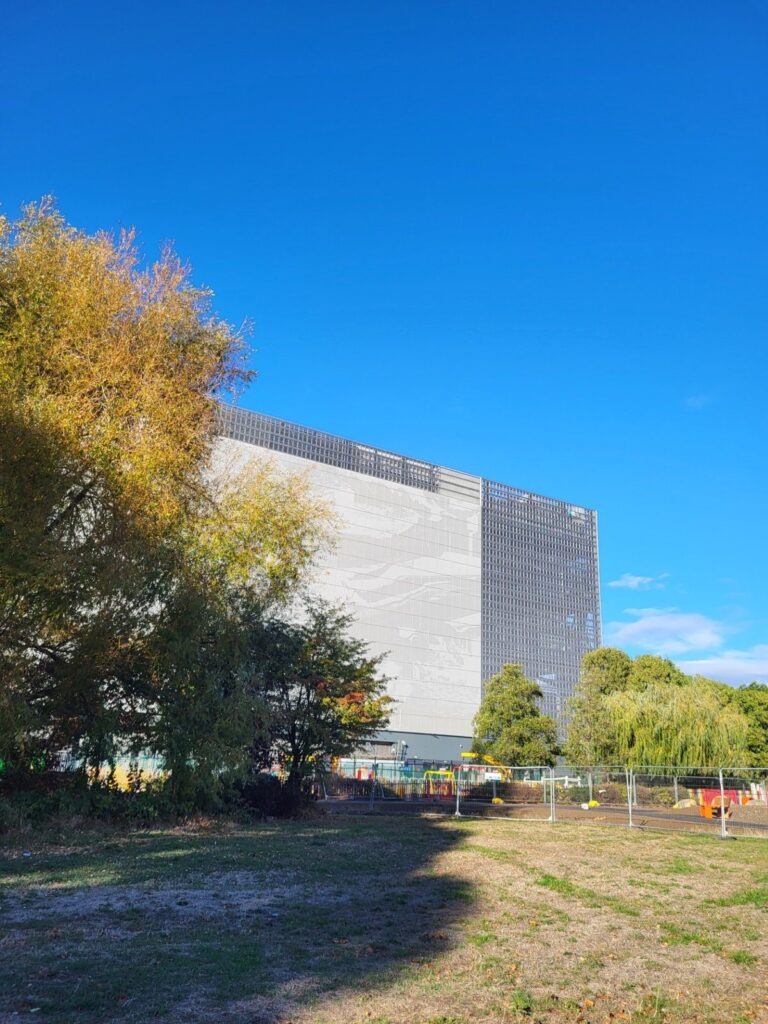
For thirty years data centres have enjoyed the same invisibility. These unassuming, anonymous windowless grey sheds on the edge of our towns, were noticed by no-one but the engineers who keep them cool, they were the equivalent of the factories and warehouses of the past.
And so, like them they have silently infiltrated our lives, yet they have gone so much further: the payment at the till, the GP’s records, the message to a child, the film downloaded on a Friday night. They are now indissolubly woven into the fabric of our lives, already part of us and our world.
Yet suddenly, the arrival of artificial intelligence has made them visible, and the data centres have become the manifestation of a big tech takeover and with that realisation the reaction has been swift.
A sense of alienation
A reaction that has been written off by many as NIMBYism. The Not In My Back Yard response of people who want the technology that runs their lives, but do not want it near them. Like those opposing electricity pylons who turn on the lights at night, they want their tech out of sight and out of mind.
Yet the evidence gathered for this month’s ‘PassW0rd’ programme suggests something larger. Campaigners, pollsters, academics and the industry itself, interviewed separately, arrive at the same diagnosis: artificial intelligence is being built into our lives faster than anyone had thought it could happen. And rather than being woven into our lives all of the headlines in the papers talk about it taking them over, of even potentially bringing about the end of humanity.
It’s a threatening world that now has a face, the data centre. And the data centre is the one part of it with a postcode, a planning application and a grid connection. It is the part people can stand outside and object against.
This is the world of the ‘the US tech bro’ in your town, and for many it’s the face of Musk, Zuckerberg, Altman and Ellison.
Do not be surprised if soon, Mount Rushmore-like, the data centres start sporting the faces of US tech billionaires. Projected onto them like the images beamed onto Windsor Castle of Jeffrey Epstein and Donald Trump together at a social event in 2004, by the protest group Everyone Hates Elon, during Donald Trump’s 2025 presidential visit.
Faceless buildings
The current facelessness of data centres is part of the issue. For a computing industry that seeks to force transparency on the population at large, the protestors claim the data centres are virtually impenetrable.
Not only do people not know what’s going on inside them, but they also say that they are not being provided with any information on their physical demands, or their environmental and economic impact.
Anderson has spent months trying to see inside them. She has sent freedom-of-information requests to Thames Water, the council and Ofwat; none, she says, could tell her how many millions of litres of drinking water the Langston Road site’s closed cooling loop will need to fill, or where the water flushed from it will go. The developers, she says, “have just not come back to us”.

Kierra Box works on the other side of that silence. She campaigns on data centres and AI for Friends of the Earth and is in touch with community groups from Epping to Park Royal in west London, where residents have been holding meetings and conducting walking tours past the data halls. She thinks the hostility has flared because the buildings have shot up like AI, with little or no warning.
Hyperscale growth has arrived in the planning system in a few short years, and what communities see, she says, are “faceless buildings with very opaque services run inside them”, offering seemingly nothing to the communities they have arrived in.
Though the buildings are no longer faceless because in another sense: they have become the face of a hitherto anonymous AI.
The environment is part of the objection, but not the heart of it. “It’s all about power and powerlessness,” she says: big technology firms have it, and the people living beside their buildings do not.
The industry hears the same complaint and offers a different diagnosis. Venessa Moffat sees the problem from both sides of the planning table: she is managing director of the Data Centre Alliance, an industry body, and a Liberal Democrat councillor in Colchester. She accepts that data centres have become “the whipping boy for AI” and that operators must be good neighbours. But the planning system, she says, does not work for them at all: there is no previous use class for a data centre, so applications are shoehorned into the B8 category for storage and distribution and judged on direct jobs they were never going to create. An industry that has long been secretive has, in her words, left “a void of information”, and its opponents have filled it.
The pollsters seeking to gauge public opinion are not finding the same void. There is a rich vein of opposition to data centres and it’s coming from across the political spectrum.
Natalie Jackson, who runs Centerline Research & Strategy and writes a column for National Journal, has spent the autumn listening to American focus groups. Data centres did not move votes on their own in the mid-terms, she says, but they fed a broader anxiety about a two tier world. Those with the techno-know how who are an incredibly ‘wealthy Technorati’ benefiting from AI, datacentres, and IT, and those who quite simply are not.
Jackson paraphrases what she heard: “AI is making a ton of money. They’re taking over our land. And we get nothing.” Strikingly, the negative reaction crosses political parties, economic groups and ages. Data centres are now AI.
“The voters think AI is making a ton of money. They’re taking over our land. And we get nothing”Voters’ view, summarised by Natalie Jackson, Centerline Research & Strategy
Communities pay price without benefit
Outside Norwich the argument has found a famous voice. Jake Humphrey, a broadcaster who grew up in the city, has recorded a video against Norwich Apex’s £1.2bn, 150-megawatt proposal on farmland at Keswick, where more than 12,000 people have signed a petition. The developer had said Norfolk might never see such an opportunity again. “An opportunity for who?” Humphrey asks. He counts 100 to 150 permanent jobs, and 72 rooftop chillers able to release 108 megawatts of waste heat, with no plan yet to use it. “Please don’t mistake our love of Norfolk for a fear of progress,” he says. “Show us the lasting benefits.” Elsewhere in the county a petition against the Longmarsh Green Energy scheme, which pairs a large solar farm with a data centre, has gathered 48,000 signatures.
“A billion-pound building is not a billion-pound gift to a community”Jake Humphrey, broadcaster
In Northumberland it’s a similar picture.
At Cambois, near Blyth, QTS, owned by Blackstone, is building a £10bn campus of ten data halls on the site of the old Blyth power station, approved in outline in March 2025.
A £3.8bn campus is proposed at West Sleekburn and a third facility at Factory Road. Residents demonstrate regularly near the site, and their complaint is less any single building than the concentration of several vast ones on a short stretch of coast.
Ian Lavery, the local MP, wants a moratorium until regulation catches up, and a “Critical National Infrastructure Levy” so that host communities share in the proceeds.
Box’s answer is that a data centre should bring its own power. Rather than plugging into the grid or buying up renewable electricity that could be decarbonising something else, a developer should build new renewable generation as part of the same application, on a site that also suits the computing. That, she argues, “shouldn’t be beyond the wit” of giant technology companies. Until data centres stop “effectively stealing energy from local communities”, or threatening to build gas plants on site, she says they will not win that part of the argument.
The economics explain why.
Professor Andrew Chien of the University of Chicago, a former vice-president of research at Intel, told Future Intelligence’s PassW0rd programme in January 2025 that data centres are in competition with people, and with wildlife, for water and power. In Virginia, data centres now take about a quarter of the grid. Yet the benefits of a data centre do not accrue to the community around it; its services are consumed globally while its environmental costs are borne locally. Northern Virginia, he notes, is effectively the Internet’s centre of mass, a concentration that owes more to inherited infrastructure than to any plan.
According to Professor Chien, data centres should be sited near renewable energy, and sustainable supplies of cooling water while still being able to supply the compute they are being built for.
Water is where the arithmetic is most often fudged. Rich Razgaitis, co-founder and chief executive of FloWater, an American drinking-water company, talks fast and with his hands, and he is scathing about the industry’s favourite answer. Closed-loop cooling, he says, saves water on site but not overall. Such systems “use anywhere from 50 to 80% more electrical power than an air-cooled system. And to generate that electricity requires copious amounts of water consumption.” He puts the share of data centres running on public drinking water at 97%. National averages, he argues, miss the point: data centres may use only 2–3% of America’s water, but “if you’re sitting in Midland, Texas, and there’s one water municipal treatment plant for you, you don’t care what’s happening nationally… All water is local.”
Razgaitis doesn’t see why data centres should drink the same water as people. There is no need he says for them to use drinking water when they can use grey or brown water.

The bill is where that competition becomes personal. Paulina Jaramillo, professor of engineering and public policy at Carnegie Mellon University and a coordinating lead author of the United Nations’ latest Intergovernmental Panel on Climate Change assessment, spoke from her office in Pittsburgh, a whiteboard behind her covered in notes on heat, hurricanes and local economies. She says she gets her electricity from PJM, America’s largest grid operator, which has struggled to buy enough capacity for the data centres queuing to join it, and consumers are seeing prices rise.
Some 75% of people surveyed would oppose a data centre in their community, she says, which means the industry has “lost a big share of their social licence to operate”. With no federal policy, states are racing one another to the bottom to attract investment, even though data centres themselves create few jobs.

Britain’s grid is under similar strain. Ofgem says the queue of demand waiting to connect rose from 41 gigawatts to 125 gigawatts between November 2024 and June 2025, at least 80 GW of it from data centres. The regulator now proposes that developers pay up to £712,500 a megawatt simply to hold their place. Box points to Park Royal in west London, where affordable housing has been delayed for want of grid connections while a nearby data-centre cluster draws up to 600 MW.
“If you’re sitting in Midland, Texas, and there’s one water municipal treatment plant, you don’t care what’s happening nationally… All water is local”Rich Razgaitis, FloWater
Out of control thinking
Back in Loughton, Anderson has read the planning documents closely. The Langston Road scheme, she says, will vent its waste heat into the air at the site boundary, and a data centre in Epping is to carry 18 generators on its roof, enough to need a special permit from the Environment Agency for the nitrogen oxides they emit. Nobody can yet tell her how often they will be tested. When she asked the developer of a third site, at Chigwell, what he would do with the heat, “they said, oh, we’re just going to pump it into the atmosphere.”
Not everyone in the industry thinks that is good enough. Mike Hoy, chief technology officer of Pulsant, which runs regional data centres, told PassW0rd in July 2024 that the coming fights would be about cooling and distribution rather than raw power. Britain, he argued, routes almost everything through London, and he wants to “move the internet north”, spreading data centres, and their heat, around the regions.
“I’m generating a load of heat,” he said. “I’m sure somebody will need some heat.” He pointed to schemes around Milton Keynes that pipe it to homes.
The most striking testimony comes from those who supply the builders. Adhum Carter Wolde-Lule is chief strategy officer of Prism Power Group, which has made the switchgear that connects data centres to the grid for more than twenty years. Calm and deliberate on screen, he might be expected to dismiss the protesters. Instead, he blames government. “There’s no policy or framework around building data centres,” he says. Ministers announce a headline and the detail never follows; what residents see in its place is “bills, water, noise, secrecy”. Grid queues are clogged with speculative “phantom projects”; one developer that has never built a data centre, he says, holds 3.4 GW of power agreements. When his industry offered to help the government draw up a framework, it heard nothing back. What investors and residents both dislike, he adds, is agreeing something and then seeing it change.

Razgaitis puts numbers on the bargain communities are offered: perhaps 700 jobs during a two-year build, “and then it’s 30 or 50 jobs thereafter”, for a building expected to stand for 40 to 60 years. Those negotiating for the community are often volunteers up against what he calls “the World Cup of lawyers”, and the terms are usually secret. In the past six months, he says, American states and local councils have begun to move against the non-disclosure agreements that keep them so. The opaqueness complained about by the Epping Forest protestor Anderson and FoE’s Box.
“There’s no policy or framework around building data centres”Adhum Carter Wolde-Lule, Prism Power Group
Location, too, has been left to accident. Slough became Britain’s data-centre capital, Moffat explains, because it happened to offer industrial land, power, fibre and a simplified planning zone. Declan Caulfield runs operations in Ireland for Socomec, a company that provides essential equipment to data centres like always on power systems. Caulfield says that there are similar reasons for developers heading to old coal, steel and car towns because that is where grid connections survive.
Nobody chooses locations as a matter of national strategy. According to some the data centre developers have deliberately picked on those areas because the local councils will be desperate for any investment, anything that promises jobs.
The case for building AI
Not everyone accepts that the objectors have a point. James Buckley-Thorp, founder of Atlian AI and a prolific commentator on the technology, leans into his microphone from a room high above the city and is blunt.
“Frankly, it’s NIMBYism,” he says. The data centre is “the new villain on the block”, the successor to the Amazon warehouse as the thing people like to protest against.
In response to the Tripods comparison, he turned it round: “the White Mountains in this circumstance is Scotland”, he said, arguing that no country is more hostile to data centres and none stands to gain more from them.
This month’s march in Edinburgh suggests he has a point about the hostility. He compares the build-out to Brunel’s railways, which were fought every mile of the way and are now part of the national inheritance. He wants planning to be fast-tracked, sites to favour existing industrial brownfield land, and towns to have no veto. “The idea that towns can have vetoes over this is economically destructive,” he argues.

Anderson’s reply is that the things people actually use already exist. “If people want to use YouTube or do all these things, we’re already doing that now,” she says. “Why is there this massive rush?”
She wants a pause, and for the people who will live beside the buildings to decide. “Why can’t we just stop now, have a little bit of a pause and just see exactly why these big tech companies want to take over our green belt and our green spaces?”

Yet even he wants Britain to be “the rule giver, not the rule taker”, and to set and enforce standards for what gets built. On that, at least, he and his opponents agree. Box is not calling for a ban. The communities she works with want moratoria and strategic plans, and she proposes an enforceable local agreement, a covenant, setting out what each data centre owes the place it occupies. The absence, she says, is “not just a policy vacuum, it’s a complete lack of a really basic business case”. Jaramillo makes a similar argument for pauses: “What the moratoriums can do is buy us time.”
“The idea that towns can have vetoes over this is economically destructive”James Buckley-Thorp, Atlian AI
No AI guidelines
Friends of the Earth Scotland has shown what organised anger looks like. On 14 November, by organisers’ estimate, some 6,000 people marched down the Royal Mile to the Scottish Parliament under the banner “Stop AI Data Centres”, part of a Europe-wide campaign backed by more than 80 organisations, from climate groups and trade unions to anti-poverty charities. They want a national public consultation before any more approvals. The Scottish Government had already paused planning decisions until Christmas while it drafts guidance on energy, water, community benefits and what should count as a “green” data centre.
Britain is not alone, and it is not even the extreme case. In America’s mid-term elections on 3 November, voters backed restrictions or bans in roughly 40 of 41 local ballot measures on data centres across ten states, from Ohio to California; the only clear vote for development came in Harwood, North Dakota. NBC’s exit poll, cited by Reuters, found that 76% of voters opposed a new data centre in their own community and that 56% called data centres a major or crucial factor in their congressional vote.
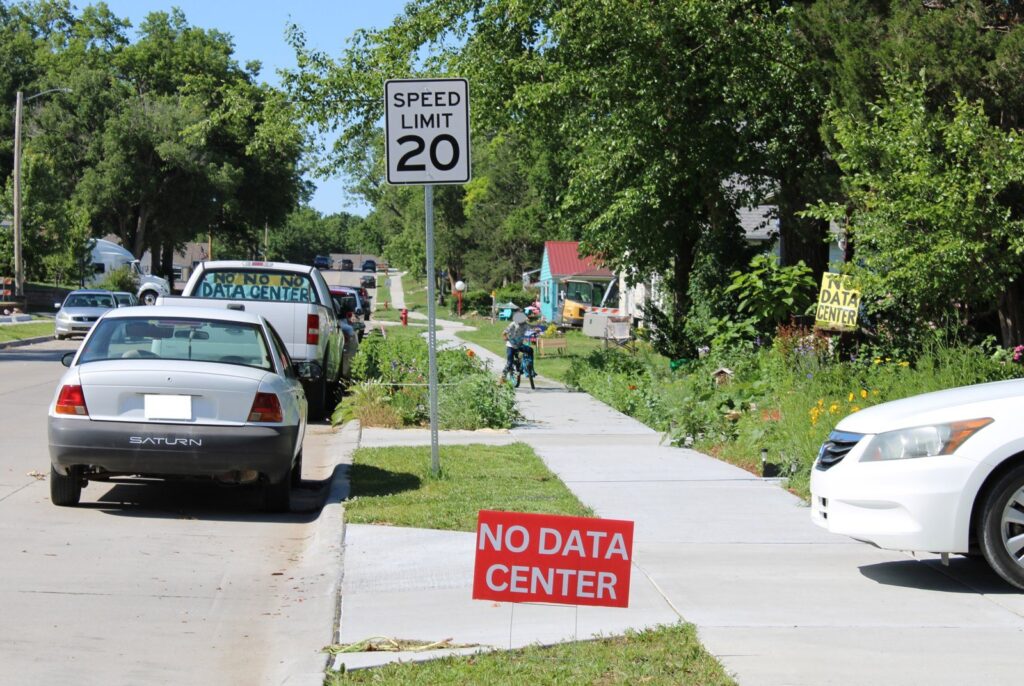
Washington has chosen its side. Donald Trump told Fox News in September that America “cannot be the stupid people that chases them out” and has called AI infrastructure “the oil of the next fifty years”. In August he wrote that communities opposing data centres “want to end up being backwards and poor”. American voters have since given their answer at the ballot box.
The protesters and the defenders, in other words, are describing the same gap. In Christopher’s novel the Tripods were tolerated for exactly as long as they went unseen; data centres have now been seen, and they will not become invisible again. AI has developed largely unfettered, at a pace that has left regulation and planning behind, and the data centre is where that gap becomes visible. The railways analogy may be apt, but not in the way its proponents intend. The railways were followed by rules on safety, on land, on who paid and who benefited, and many of those rules came because people objected.
Back in the UK, Change.org lists 63 petitions against data centres, with more than 259,000 supporters between them.
Britain’s Cyber Security and Resilience Bill will, for the first time, bring data centres within the scope of national infrastructure regulation. That is a start on security; it says nothing about where they go, who pays for their power or what the neighbours receive. Until a government answers those questions, every planning application will be a referendum on AI itself. The backlash may yet prove to be how AI finally acquires a policy.
Back on the far side of Epping Forest, Anderson is still waiting for the Environment Agency to answer her about the generators. She does not expect to win every argument. “In my case, I just want them banned anywhere near Epping Forest,” she says. “But this is a global phenomenon, an absolute global phenomenon.”
The data centre backlash is this month’s edition of the PassW0rd radio programme on Resonance FM, written and presented by Peter Warren and produced by Blue Buffery. Further programmes and research can be found at www.futureintelligence.co.uk