
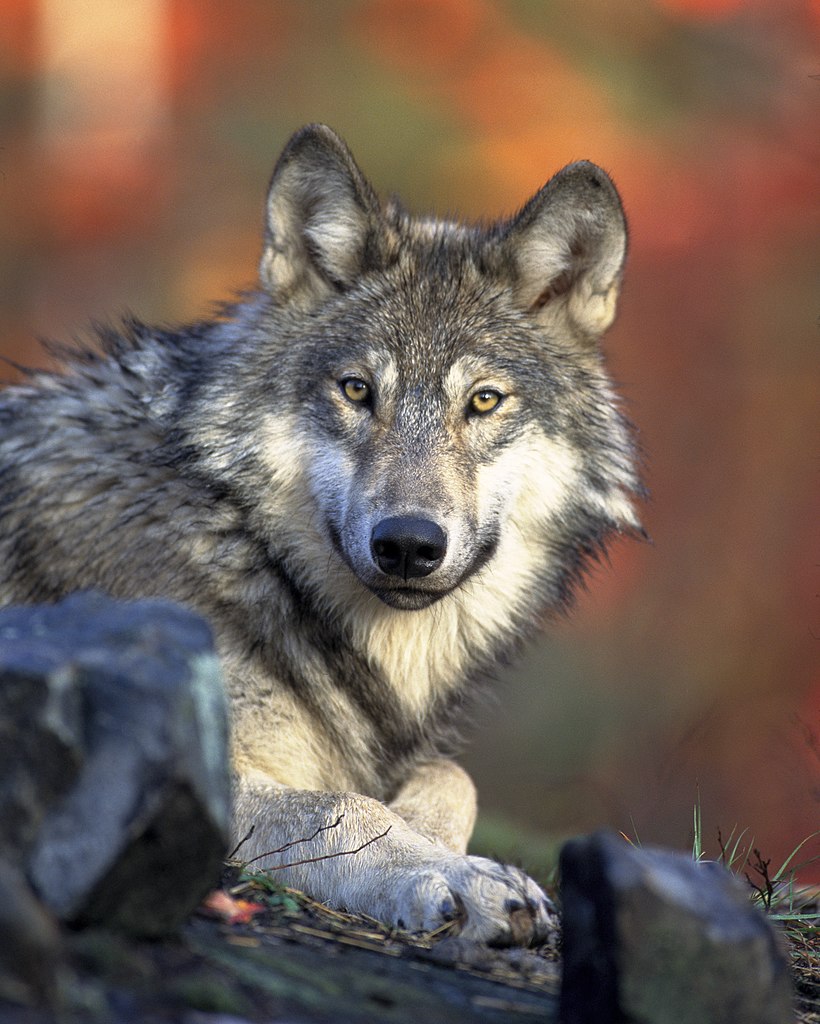
at this page and is public domain.
“With this research we can change dog’s behaviour,” said Dr Danika Metallinos, a veterinary geneticist working on the project. “The behavioural problems associated with many dogs are inherited and there are people who are very interested in modifying that behaviour.”
Work that could produce some potentially worrying results for humanity as research as already indicated the existence of a domestication gene in dogs, valued as a desirable attribute, due to this successive generations of domestic pets now differ considerably from their wild relatives.
Dog-breed bores may dispute the attractions of developing the canine equivalent of the robot women in the 60s cult film ‘The Stepford Wives’ who carried out every whim of their male masters, but for many, a Yorkshire Terrier without the yap or a Mastiff without the malice would be seen as a definite bonus.
But before the Kennel Club begins a stampede to join the anti-genetic modification lobby it is only fair to point out that many of the defects the team hope to iron out have been caused by man as many a snuffling, bandy-legged bulldog will testify to.
“Our main aim is to have all of the dogs within a particular dog breed healthy,” said Metallinos. “We can’t do anything for bull-dogs because their problems are physical and due to their facial characteristics, but we can remove the ailments that affect particular pure breeds.”
Eradicating human bred breed flaws
Meaning the Red Setter’s tendency to suffer from sudden fatal fits, the Alsatian’s hip problems or the Doberman’s ironic susceptibility to Van Willebrand’s disease, a condition which means that the classic guard dog can often bleed to death, could become footnotes in dog-breeding history.
The eventual aim of the work is to create a ‘virtual canine catalogue of all dogs’.
The system works by analysing nuclear DNA samples taken from particular animals, this gives the combined genetic code of both a dog’s parents and then digitising the results. By cross-referencing that information against code taken from the parent itself, sub-sets of genetic information can be isolated so the bloodline delivering a particular genetic tendency can be identified.
It is then hoped that similar comparisons between the DNA of healthy and unhealthy dogs in the same families would pin-point the faulty genes.
“We would then be able to identify carriers and stop them from breeding together. So that over time we would be able to eliminate genetic weaknesses,” said Metallinos.
Dog database aims to solve canine paternity suits
Funded with a £200,000 grant from the American Kennel Club, it will come as no surprise that the database will also be used to prove canine paternity suits to prevent unscrupulous dog-breeders claiming a more aristocratic canine ancestry for the animals they are selling than is the case.
Comparing DNA from the parents should rapidly eliminate any pretender to a dynastic dog-basket according to the team, who will also be working to build breed blueprints from the dog database.
A tracking of canine desire that will almost certainly reveal where some dogs have strayed from the arranged marriages engineered for them by their breeders.
But as well as sorting out just whose leads had become romantically entwined, the database will also be used to address some more serious scientific questions, such as whether the selective breeding of dogs has shrunk the gene pool of the species.
A question the UCL database will look at by taking over 200 samples from wild dogs around the world including Alaskan wolves, Australian dingoes, Carolina dogs, Korean Jindo dogs and the quaintly named New Guinea singing dogs, a breed which literally yodel in the jungle.
Work that may help put new life into our old dogs according to Niels Pedersen, another team member.
“If the collective diversity among all of the registered breeds is still equal to that of the ancient dogs it will make it a lot easier to restore genetic vigour to troubled breeds,” said Pedersen.
“The question is how much genetic diversity was there in dogs before pure breeds began about a century ago?”
And if all goes according to plan, over-laying the mass of genetic information the team aim to collect could even yield the origins of the Grand Doggy of them all, the first dog to stagger into the light of the campfire around 80,000 years ago, 76,000 years before the cat made it to the hearth.
Though not quite Jurassic Bark it is a creature the team hope to be able to put some flesh on.
“It’s still very much in debate whether dogs are closely related to wolves, and it is more likely that dogs evolved from a definite sub-species of wolf,” said Alison Schaffer, one of the project’s researchers, who would not comment on whether the team were considering naming such a sub-species the ‘Stepford Wolf’.
Published Scottish Sunday Herald


